
How To Use Creative Financing to Sell Your House
Looking Beyond the Traditional Real Estate Market
When most people think about selling a house, they picture the traditional retail route. You hire an agent, place the property on the market, host showings, and wait for a buyer to secure a conventional bank loan.
While this process works well for many properties, it is not the only option available.
For homeowners facing unique timelines, property challenges, financial pressure, or strict lending limitations, forcing a traditional sale can sometimes lead to delays, uncertainty, and stressful underwriting obstacles.
This is where creative financing frameworks may become worth exploring.
Rather than relying entirely on conventional lending, creative financing focuses on alternative property structures designed around flexibility, customized timelines, and practical agreements that better fit the situation.
What Exactly is Creative Financing?
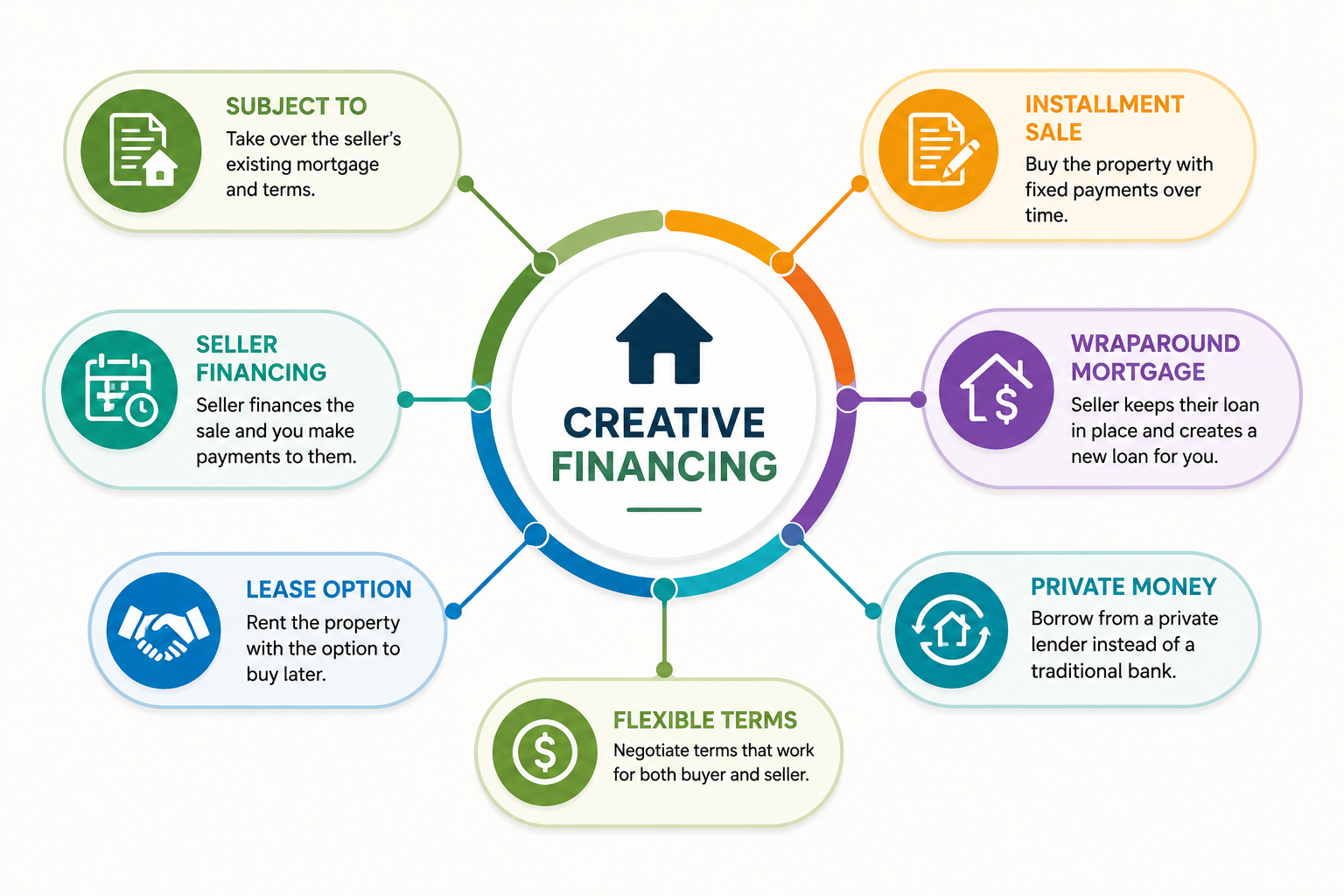
In simple terms, creative financing refers to structuring a property sale without depending entirely on a traditional bank mortgage or a large upfront cash purchase from a conventional buyer.
Instead, buyers and sellers work together to create alternative payment arrangements tailored to the needs of the property and the goals of both parties.
Because these structures may reduce dependence on traditional bank underwriting, they can sometimes create more flexible timelines and fewer financing-related delays compared to conventional transactions.
Creative financing is not one single strategy. It is a broad category of structured property arrangements that may offer alternative paths when traditional selling methods do not fully align with a homeowner’s circumstances.
Benefits of Creative Financing
Exploring non-traditional property structures may provide several practical advantages that are often difficult to achieve through the standard retail market.
🔹 Reduced Dependence on Traditional Lending Timelines
Conventional real estate transactions often rely heavily on strict underwriting, debt-to-income calculations, appraisals, inspections, and final loan approval conditions.
Certain creative financing structures may reduce delays tied to those traditional lending requirements.
🔹 Greater Flexibility for Property Condition Challenges
Some conventional loan programs place restrictions on homes requiring major repairs or deferred maintenance.
Creative arrangements may provide more flexibility for properties being transferred in their current condition.
🔹 More Private Transaction Structures
Traditional listings often involve public marketing, multiple showings, and ongoing public exposure throughout the sales process.
Creative financing structures are frequently arranged through direct private agreements between the parties involved.
🔹 Customized Timeline Possibilities
Instead of relying entirely on standard escrow timelines, some creative arrangements allow greater flexibility around move-out schedules, payment timing, or transition planning.
How Creative Financing Helps Sellers
Creative financing is not simply an alternative transaction method. In some situations, it can serve as a structured problem-solving framework for homeowners facing specific financial or logistical challenges.
🔸 Little or No Equity Situations
Homeowners who purchased recently—or who owe close to the property’s current market value—may discover that traditional commissions and closing costs leave little financial room in a conventional sale.
Certain creative structures may offer alternative transition possibilities depending on the situation.
🔸 Mortgage Payment Pressure
When homeowners experience financial hardship or payment-related stress, some structured arrangements may allow another party to maintain ongoing payment responsibilities under agreed terms.
🔸 Landlord or Vacancy Fatigue
Managing long-distance properties, difficult tenants, or ongoing vacancy issues can become overwhelming over time.
Some creative structures allow owners to step away from day-to-day property responsibilities while creating a more passive arrangement.
🔸 Time-Sensitive Situations
Homeowners working through relocation deadlines, inherited property transitions, or major life changes may seek alternatives to lengthy traditional listing timelines.
Creative structures sometimes provide more predictable transition planning depending on the agreement terms.
Three Common Creative Financing Structures
Depending on your goals and your property’s current financial position, there are several creative financing structures worth understanding conceptually.
1. Subject-To Arrangements
If your property has little or no equity, or if you are experiencing ongoing mortgage payment pressure, a Subject-To arrangement may be one possible structure to explore.
In this type of setup, the existing mortgage remains in place while another party agrees to maintain responsibility for the ongoing monthly payments, taxes, and insurance obligations under agreed terms.
For some homeowners, this structure may provide an alternative path when traditional selling methods create financial strain or timeline challenges.
2. Seller Carrybacks (Owner Financing)
If you own your property free and clear—or hold significant equity—you may have the ability to structure the sale through Seller Carryback Financing.
Rather than requiring the entire purchase amount upfront, the seller agrees to accept structured installment payments over an agreed timeline.
For some property owners, this type of arrangement may create a more gradual income stream while reducing landlord responsibilities, vacancy concerns, or ongoing property maintenance obligations.Want to see which alternative framework fits your specific situation?
3. Lease-Option Structures
A Lease-Option combines a lease agreement with a future option to purchase the property.
Under this arrangement, the occupant leases the home for an agreed period while maintaining the contractual opportunity to purchase the property before the agreement expires.
For some homeowners, this structure may create immediate monthly income while allowing additional flexibility around future transition planning and timing.
The Bottom Line
Creative financing is not about complex legal loops or high-pressure pitches. It is simply a practical toolkit that offers alternative property options when traditional bank lending doesn't fit your timeline or goals. Understanding how these frameworks operate ensures you can evaluate your choices calmly and move forward on your own terms.
Explore Your Situation Further
Want to better understand which structured property framework may align with your situation?
Check your details using our interactive tool. https://sellwithrelief.co/self-guided-tool
